Saturday, December 15, 2012

Windows on a Budget

  • invest·ment  

    • /inˈves(t)mənt/
      Noun
        • A thing that is worth buying because it may be profitable or useful in the future.

This definition doesn't tell the complete story about "investments", does it?  We all know that there are GOOD investments and bad ones.  The best investments pay off in the short term and continue into the long term.  Windows can be that kind of investment but lets not pretend that there is no risk.  Is there anything better for your budget than making a good investment?  Is there anything worse than a bad one?  Just like every other important purchase that you make for your home, underpaying for windows can be as dangerous as overpaying for them.
Our advice is to avoid paying for labels.  Most of our customers are surprised when they learn that the best buys on the window market are usually from manufacturers that they've never heard of.  Most of the most familiar window manufacturers actually specialize in "New Construction" and in our opinion remain behind the curve on "Replacement Windows" (an entirely different animal).

The key to finding a window that saves long-term money without breaking the short-term budget is to work with a company that can offer estimates on multiple budget windows.  Some manufacturers provide great prices for large windows, others for small windows.  Some manufacturers provide better prices for colors or styles.  Not all "Single Hung" windows are cheaper than "Double Hung" and sometimes the most efficient glass doesn't make the most efficient window.

We at Adams Home Windows consider it our job to find each homeowner the deal that will work for both their short & long term budget.  Remember to check our Twitter feed for updates on Manufacturer promotions and deals.  We update it often.


Energy Efficient Windows

Before I write a blog about window efficiency, I suppose that I should first ask the question,"Efficient for who?".  Making a window energy efficient for a northern climate means Triple Pane Glass, large I.G. units and heavy inert gas between the panes.  Southern climates depend more upon high quality LowE.


The Low E (Low Thermal Emissivity) Situation:
Objects that are highly thermally emissive simply get hot when heat is applied.  Imagine walking bare-foot across a black pavement parking lot in the summer.  Black pavement has a HIGH low-e rating because it doesn't reflect the suns heat.  Black pavement absorbs the suns heat and radiates it.  White pavement, on the other hand, reflects more of the suns heat, meaning that it has a lower rating.
Glass actually has a fairly high "Low E" rating (like Black Pavement).  However, quality glass manufacturers can add a metallic mixture consisting primarily of tin or silver to the glass that significantly reduces the "Low E" rating.  The idea is that eventually this Low-E metallic mixture will only effect the UV spectrum and block 100% of the invisible "Heat Light" while allowing 100% of the visible light.  Unfortunately, we aren't there yet.  Very Energy Efficient windows are now capable of blocking up to 80% of the heat-light (UV) while only blocking 5% of the visible light (barely tinted).  Severely tinting (reducing the amount of light that comes through) your windows is no longer the smart way of reducing the amount of heat.

Pane Thickness (Double and Triple):There is the issue of thermal conductivity.  Think of it this way... if you had a ruler that was made of iron and you heated only one end, that heat would eventually conduct all the way to the other end.  Thermal conductivity also applies to glass.  If the sun heats up one side of the glass, how long will it take before the other side gets hot?  The obvious next question is: if the sun heats up one side of the glass, how long until the inside of your home gets hot?   We can significantly reduce this conductivity by adding another pane of glass with a large airspace between them.  This means that heat (or cold) will have to conduct through the glass, heat (or cool) the airspace to such extremes that it then conducts through the second pane of glass.

Gas (Argon / Krypton):Hot air rises and cold air falls.  This also happens in the air space between the two (or three) panes of your window glass.  This "rolling" effect causes heat (or cold) to conduct faster and a window to break down quicker.  We can reduce this effect by replacing the air with gas.  Argon and Krypton gas are much heavier than air and both resist the rolling effect.


Friday, September 14, 2012

Vinyl, Aluminum, Wood or Fiberglass?

Recently, we have been talking to some potential customers who have mentioned our "pro-aluminum" competition. Of course we understand that we still have some "old school" window competition around Dallas who have exclusive deals with aluminum window manufacturers. Heck, even we still sell Aluminum Windows on occasion. But to argue that aluminum windows are in any way superior to vinyl windows is just irresponsible of any window company who plans to remain in business long-term..
Industrial WindowsFolks, the windows that you currently have are probably aluminum. And how old are they? 15 - 20 years old? Simply walk over to your existing windows and examine their condition. Aluminum replacement windows fade, corrode, conduct heat/cold, conduct sound, they often "rattle" and the seals never last very long. Aluminum windows become hard to open and sometimes difficult to keep open (SLAM).
Every summer day the Texas sun heats the exterior of an Aluminum window to extraordinary temperatures, melting the silicone seals. That evening those seals re-congeal when the temperature drops. Repeat... month after month, year after year. This cycle is one of the reasons that your windows are so drafty. Also, because Aluminum conducts so well - when the exterior aluminum gets hot/cold the interior also gets hot/cold. The inside aluminum temperature simply radiates through the room as if it were a space heater or A/C vent.

Vinyl Windows on the other hand, are terrible conductors of heat/cold. They don't get nearly as hot and the seals stay in tact throughout the summer. Vinyl doesn't corrode like Aluminum and they tend to "flex" with the movement of Dallas homes, allowing them to smoothly open and stay open throughout the lifetime of the home. Aluminum windows can be painted. That is the only edge that they have on Vinyl. But in Dallas - a painted window must eventually be re-painted. Vinyl is virtually maintenance free.

Wood Windows are the most energy efficient type of window but most of our potential customers simply can't afford them.  Of course, wood is paintable and easy to match to your existing interior / exterior but if you paint them you must ALWAYS paint them.  Yes, they are more decorative but those decorative moldings rot and decay.  There is a risk of buying an expensive window that will need to be replaced relatively quickly if the homeowner forgets about inspections or painting for a season.  However, for those diligent homeowners who can afford them, wood is an extremely attractive option that adds warmth and beauty to a house.

I'm sure that some of our competition and any manufacturer who offers them will disagree with our opinion of fiberglass windows.  Unfortunately, the truth is the truth.  Fiberglass windows are not only expensive, they are brittle.  It is very common to see splintering and cracking relatively quickly with fiberglass windows and they're (in our opinion) just too expensive to have such expensive problems.  Of course, there are salesmen out there who make huge profit margins from selling fiberglass windows but Adams Exteriors is still searching for one that we can stand behind.  Check back in a few years.
        

Friday, June 1, 2012

Sloped Sill vs. Pocket Sill vs. Stepped Sill

Here at Adams Home Windows, we frequently get asked about the different types of available window sills.  When multiple companies are competing for a job, it's not unusual for one of them to proclaim their window superior because of the design of the sill.  Sketchy salesmen are very quick to inform confused homeowners of the gloom and doom of buying any window but theirs.  Usually this includes statements like: "Slope sills are cheap and not rigid enough", "Pocket sills will leak and the weep holes clog up", "Step sills are new and unproven".

Please keep in mind that reputable window manufacturers have been selling and warrantying each type of window sill for a long time.  If it were true that any of these types of sills were unreliable, these companies would surely have re-designed their product by now.

However, lets take a look at each ~
Slope Sills shed use a thin piece of vinyl to lock the sash into when it closes.  Other than this... it's exactly what the name implies, "sloped".  If the screen is up and rain is allowed to splash directly onto the sash, the water will run down to the sill and run off.  Simple stuff.  This works.

Pocket Sills use a cup design that the sash closes into.  If the screen is up and rain is allowed to splash directly onto the sash, the water will run down into the pocket and drain out of the "weep holes".  This works.  However, it's a good idea to keep the screen on the window... you don't want dirt and leaves clogging up the drainage.  The benefit of a Pocket Style frame is that it's bulkier and more rigid.  Some customers might prefer a stronger frame for larger windows.


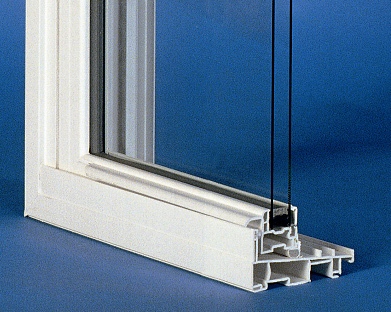
Step Sill is a hybrid of both Slope and Pocket sills.  The sash closes into a pocket and uses an outside slope design to direct water off of the sill.  This works.  There aren't as many "honey combs" inside this frame as there is inside of Pocket style frames so the window itself won't be as rigid and sturdy, but there should be no reason for worry.  Again, if the screen is down only a small amount of water will need to be drained by the sash.


Window Replacement DIY

From removing the window seals and the glass to installing the window.  This can be a dangerous job without the tools and experience of a professional. 

Unfortunately, it would be very difficult to write an actual DIY about how windows are installed.  Is the exterior product Brick?  Wood?  Stucco?  Is the interior product Sheetrock?  paneling?  wood?  What type of window are you installing?  Vinyl, Wood, Aluminum or Fiberglass?  Every factor changes the process.

However, there are some general rules that apply to every project.  First: Glass is dangerous!!!  When you're removing glass, try to stay above it.  Falling glass can obviously hurt you... it can kill you.  BE CAREFUL.  Second: Measuring correctly makes every job easier.  Replacement windows are almost always custom sized and ordered.  So, take your time and make sure that you're ordering a window that will fit.  Have a plan. 

Obviously, hiring a professional would be a good idea.


Burglar-proof Windows

"Burglar-Proof"?  Well, I suppose they are as burglar-proof as anything can be. 


I think that it's safe to say that aside from simply walking through the front door, breaking a window is probably the most common way to break into a house.  But, what if the glass broke but didn't break through.  How many times would a burglar loudly beat on a window before getting frustrated and moving on? 

Burglar-proof windows use a heavy polyurethane laminate sandwiched between two pieces of glass to form a window that is not only extremely efficient, it's also extremely difficult to break through.  Now, if a burglar is smart enough to stop whacking on it and pry the window open, it could still be possible to break the lock.  But the questions are:  How much noise is this burglar going to be comfortable with making?  How long is the burglar going to be willing to "problem solve" this frustrating window?  What are the chances that you'll be inside and not hear the racket that the burglar is making? 

Of course, a homeowner can always install "burglar bars" on their windows.  But, what happens in case of a fire?  Being locked behind bars, imprisoned in your own house is probably not a great idea.  Besides, burglar bars don't exactly add to the look of a home.